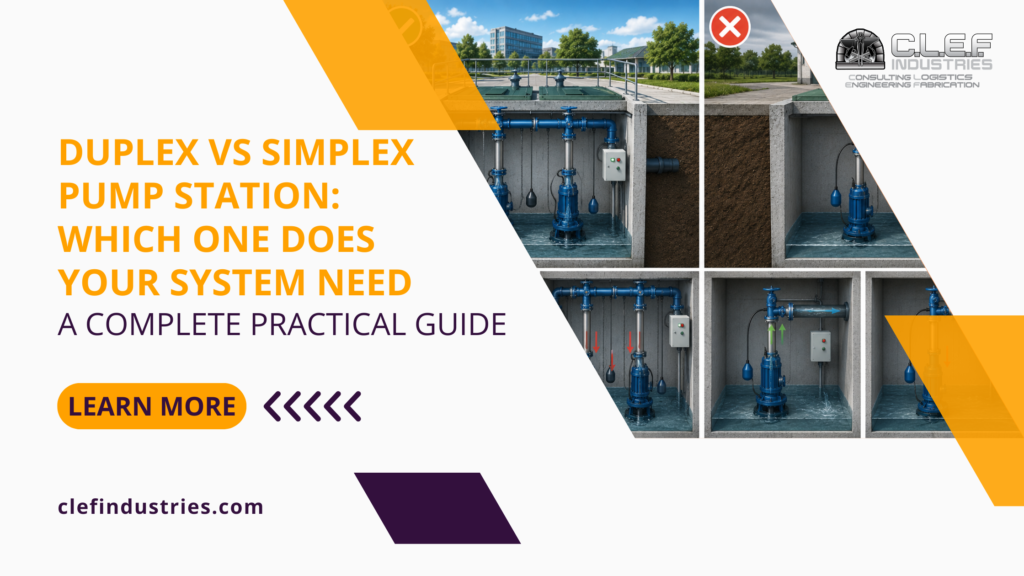
Choosing how many pumps your station needs is one of the most important decisions in any pumping project. Get it right, and you have a system that runs efficiently for years with minimal downtime. Get it wrong, and you risk overflows, premature pump wear, and expensive emergency repairs. The choice usually comes down to two configurations: a simplex pump station with one pump, or a duplex pump station with two. This guide breaks down how each works, where each one fits, and how to decide which configuration your system actually needs.
What Is a Pump Station
A pump station is a system that moves water, wastewater, or stormwater from a lower point to a higher one, or from one location to another, when gravity alone cannot do the job. A typical station includes a wet well that collects incoming flow, one or more pumps, level sensors or float switches that tell the pumps when to run, a control panel that manages operation, and the discharge piping and valves that carry flow out of the station.
The number of pumps inside that station defines its configuration. One pump is a simplex station, two pumps are a duplex station, and stations can scale further to triplex, quadplex, and beyond when flow demands require it. Simplex and duplex are by far the two most common choices, and the difference between them affects reliability, cost, and long-term performance.
What Is a Simplex Pump Station
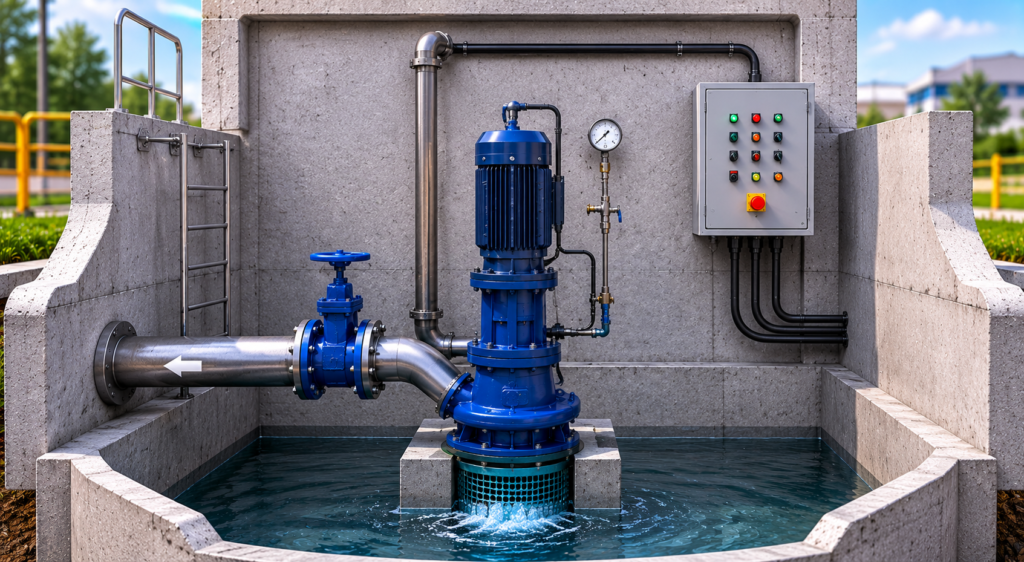
A simplex pump station uses a single pump to handle all of the fluid it needs to move. It is the simpler and lower-cost of the two configurations and is most often installed in residential or light-duty applications where the flow is predictable, and an occasional interruption is not a serious problem.
How a Simplex System Works
In a simplex system, the level in the wet well rises as flow comes in. When the water reaches a preset level, a float switch or level sensor signals the control panel to start the pump. The pump runs until the level drops to the preset off point, then it shuts down and waits for the next cycle. A separate high-water alarm float is usually included to warn the operator if the level climbs too high, which is the main signal that the single pump cannot keep up or has failed.
Advantages of a Simplex Pump Station
- Lower upfront cost. One pump, a smaller control panel, and a simpler wet well mean lower equipment and installation costs.
- Simpler design and controls. Fewer components make the system easier to install, understand, and troubleshoot.
- Smaller footprint. A single pump station can fit into a more compact wet well and site layout.
- Lower maintenance scope. With only one pump and one set of controls, routine service involves fewer parts.
Limitations of a Simplex Pump Station
- No backup. If the single pump fails or clogs, pumping stops entirely until the pump is repaired or replaced. In a wastewater system, this can mean a backup or overflow.
- Concentrated wear. Because one pump does all of the work, it accumulates run time faster and tends to wear out sooner.
- No maintenance flexibility. The pump cannot be taken offline for service without shutting the station down.
- Limited peak capacity. A single pump must be sized for the highest expected flow, which can make it oversized and less efficient during normal daily flows.
What Is a Duplex Pump Station
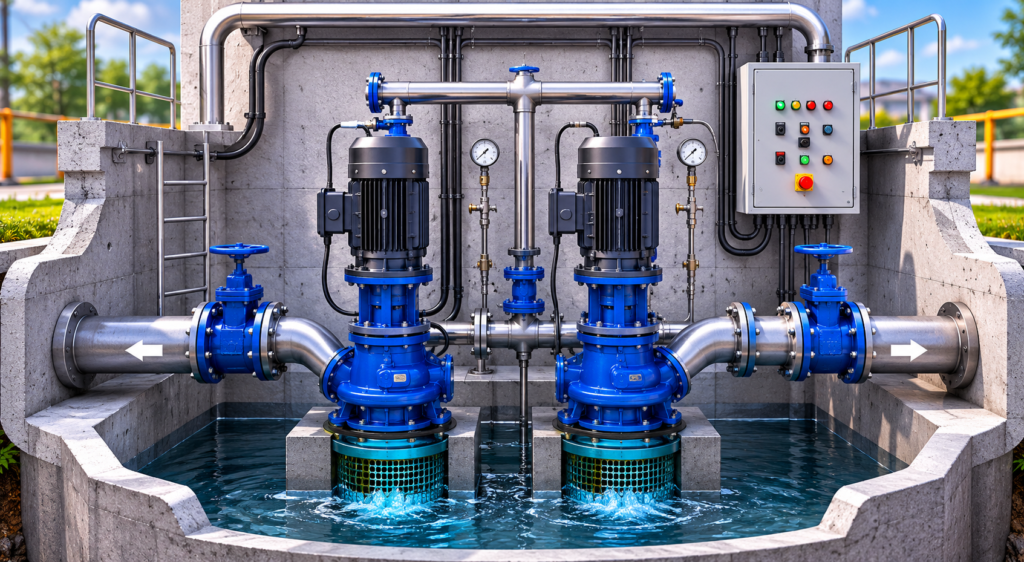
A duplex pump station uses two pumps that work together. It is the standard choice for municipal, commercial, and most wastewater applications because it adds redundancy and lets the pumps share the workload. The defining feature of a duplex station is lead and lag operation.
How a Duplex System Works
In a duplex system, the two pumps operate in a lead and lag arrangement. The control panel designates one pump as the lead, which starts first and handles normal daily flow. If incoming flow rises faster than the lead pump can keep up, the level continues climbing to a second set point, and the lag pump starts to provide additional capacity. Once the level drops, the pumps shut off in sequence.
A key part of this design is automatic alternation. Each time the station cycles, the controller swaps which pump is designated lead and which is lag, so the two pumps share run time evenly. This alternation reduces wear and keeps both pumps in regular operation. Critically, if the lead pump fails or is clogged, the controller automatically calls on the other pump, so the station keeps running. This is what gives a duplex station full redundancy.
Advantages of a Duplex Pump Station
- Built in redundancy. With two pumps, the failure of one does not stop the station. The second pump maintains operation, which is essential for avoiding overflows in wastewater systems.
- Even wear through alternation. Automatic alternation balances run time between the pumps, extending the life of both.
- Better efficiency across flow ranges. One pump can handle low daily flows efficiently while both pumps combine to meet peak flow, instead of running one oversized pump all the time.
- Maintenance without shutdown. One pump can be pulled for service while the other keeps the station running.
- Handles peak flow safely. Wastewater stations are designed for a peak flow that may rarely occur. Two pumps let the station meet that peak without a single oversized, inefficient pump.
Limitations of a Duplex Pump Station
- Higher upfront cost. Two pumps, a larger control panel, and a bigger wet well increase equipment and installation costs.
- More complex controls. Lead and lag logic, alternation, and additional level set points add complexity to the control system.
- Larger footprint. Two pumps require a larger wet well and more space.
- More components to maintain. With two pumps and more advanced controls, there are more parts that need routine attention.
Duplex vs Simplex Pump Station Key Differences
The two configurations differ most in four areas: redundancy, capacity, cost, and maintenance.
| Factor | Simplex Pump Station | Duplex Pump Station |
|---|---|---|
| Number of pumps | One | Two |
| Redundancy | None, the station stops if the pump fails | Full, second pump takes over automatically |
| Operation | Single pump runs every cycle | Lead and lag operation with automatic alternation |
| Capacity for peak flow | The single pump must be sized for the full peak | Two pumps combine to meet peak flow |
| Pump wear | Concentrated on one pump | Shared evenly between two pumps |
| Upfront cost | Lower | Higher |
| Footprint | Smaller | Larger |
| Maintenance | Requires a full shutdown to service | One pump can be serviced while the other runs |
| Best suited for | Residential and light duty | Municipal, commercial, and wastewater |
Redundancy and Reliability
This is the single biggest difference. A simplex station has no backup, so a failed or clogged pump stops the station completely. A duplex station has a second pump that the controller brings online automatically, so a single pump failure does not interrupt service. For any application where an interruption causes a backup, overflow, or safety issue, redundancy is the deciding factor.
Capacity and Flow Demand
A simplex pump must be large enough to handle the highest flow the station will ever see, which can leave it oversized and inefficient during normal flows. A duplex station splits the job: one pump manages everyday flow efficiently, and the second pump joins in only when peak flow demands it. This makes a duplex station better suited to systems with a wide range between daily and peak flow.
Cost and Installation
A simplex station costs less to buy and install because it has fewer pumps, a simpler control panel, and a smaller wet well. A duplex station costs more upfront for the opposite reasons. However, the gap narrows over time because the duplex station avoids the cost of oversizing a single pump and reduces wear-related repairs through alternation.
Maintenance and Downtime
In a simplex station, servicing the pump means taking the whole station offline. In a duplex station, one pump can be removed for maintenance while the other continues to operate, so routine service does not force a shutdown. Over the life of the system, this difference can significantly reduce downtime.
When to Choose a Simplex Pump Station
A simplex pump station is a sound choice when the application is low risk and cost matters most. It tends to fit single-family homes and small residential systems, light-duty applications with low and predictable flow, sites where a temporary pumping interruption is acceptable, and projects with tight budgets where redundancy is not required. If a brief outage would not cause a backup, overflow, or safety problem, a simplex station can be the right, economical solution.
When to Choose a Duplex Pump Station
A duplex pump station is the better choice whenever continuous operation matters. It is the standard for municipal and commercial wastewater systems, sewer lift stations, stormwater and flood control, and any site where an overflow or shutdown is unacceptable. It also fits systems with a large gap between daily and peak flow, and any application where the pumps need to be serviced without stopping the station. Because it offers redundancy, even wear, and safe peak capacity, the duplex configuration is the most common solution in professional pump station design.
How to Decide: Key Factors to Consider
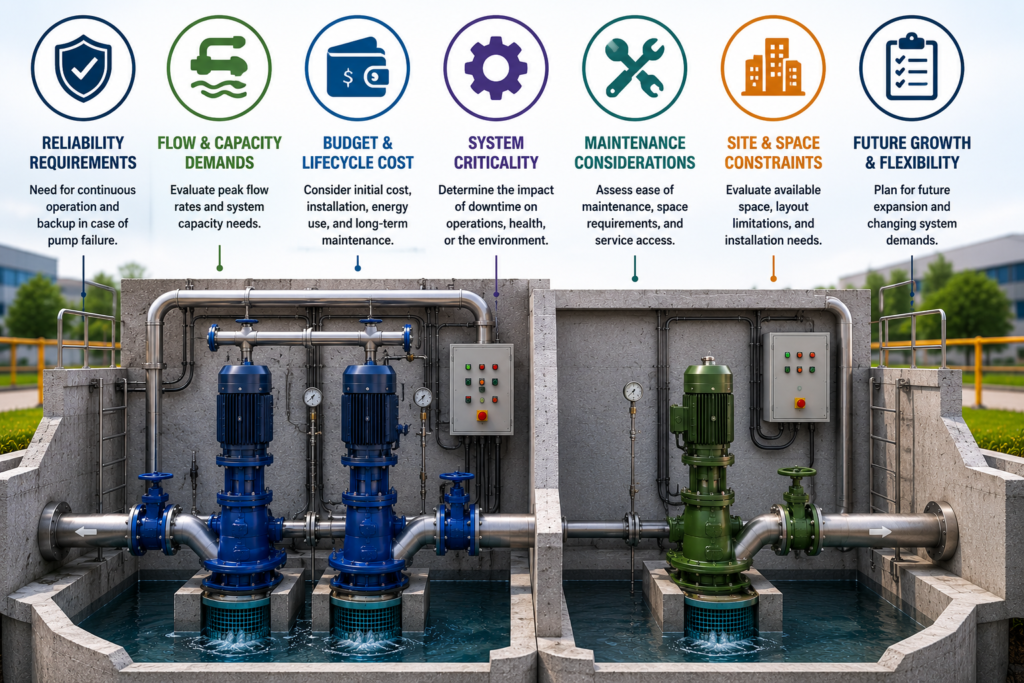
Choosing between the two configurations comes down to weighing risk, flow, and budget for your specific site.
Flow Rate and Usage
Look at both your average daily flow and your highest expected peak flow. If the two are close and consistent, a single pump may handle it well. If there is a wide gap between normal and peak flow, a duplex station handles both ranges more efficiently and safely.
Criticality of the Application
Ask what happens if the pump stops. If a short interruption is harmless, a simplex station may be fine. If a stoppage would cause a sewage backup, flooding, environmental violation, or a safety hazard, redundancy is not optional, and a duplex station is the right call.
Budget vs. Long-Term Risk
A simplex station saves money upfront, while a duplex station costs more initially but protects against the far higher costs of downtime, emergency repairs, and overflow cleanup. The right decision balances the available budget against the real cost of a failure at that site.
Get Expert Help Designing Your Pump Station
Choosing the right configuration is easier with experienced engineers who can size the system to your actual flow and reliability needs. For over five decades, CLEF Industries has designed, built, installed, and maintained pump stations across the Northeast. Our team handles complete pump station design and installation, from sizing pumps and wet wells to engineering the controls that run lead and lag operation, along with ongoing repair and maintenance to keep your station reliable.
Whether you are planning a new simplex system for a light-duty site or a fully redundant duplex station for a municipal or commercial application, we can help you choose and build the right solution.