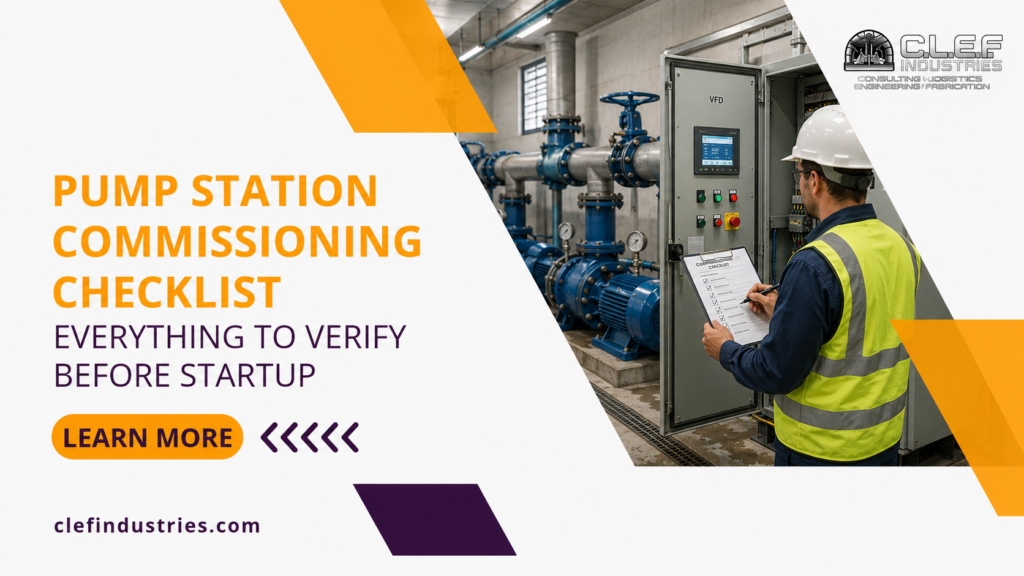
A pump station commissioning checklist helps verify that pumps, motors, controls, sensors, valves, and safety systems are ready before startup. Even when installation work appears complete, the station should not enter full operation until its mechanical, electrical, hydraulic, and control components have been properly inspected and tested.
Commissioning is the final quality-control stage between construction and dependable operation. It confirms that the installed equipment matches the approved design, the pumps perform as expected, the control system responds correctly, and the alarms and emergency systems operate when required.
For municipal, commercial, industrial, irrigation, golf course, and wastewater applications, incomplete commissioning can result in unstable pressure, nuisance alarms, incorrect readings, motor overloads, pump damage, and unnecessary downtime. Following a structured process allows technicians to identify these issues before they become expensive service calls.
What Is a Pump Station Commissioning Checklist?
A pump station commissioning checklist is a structured guide used to verify that every part of a pump station has been installed correctly and operates as part of one coordinated system. It involves much more than energizing the equipment and confirming that a pump starts.
Technicians compare the installed equipment with approved drawings, verify pump and motor specifications, inspect piping and valves, test electrical connections, configure Variable Frequency Drives, calibrate sensors, and confirm the station’s automatic operating sequence.
The objective is to prove that all components work together under realistic conditions. A pump may operate correctly on its own but still perform poorly if the VFD is programmed incorrectly, a valve is in the wrong position, or a pressure transducer is providing inaccurate feedback.
| Commissioning area | What should be verified |
|---|---|
| Mechanical equipment | Pumps, motors, valves, piping, supports, and alignment |
| Electrical systems | Wiring, grounding, overloads, breakers, and panel components |
| Controls | Start-stop logic, sequencing, VFD settings, and automatic operation |
| Instrumentation | Pressure, flow, level, temperature, and alarm accuracy |
| Performance | Flow, pressure, amperage, vibration, noise, and temperature |
| Safety | Emergency stops, backup power, alarms, and operator procedures |
A complete commissioning record also creates a baseline that can support future maintenance and troubleshooting.
Why Pump Station Commissioning Matters
A station can pass a basic visual inspection while still containing faults that only become apparent after power is applied or fluid begins moving through the system.
Common startup problems include incorrect motor rotation, loose wiring, poorly configured VFD settings, inaccurate sensor calibration, closed valves, and faulty alarm communication. These issues can reduce performance or cause serious equipment damage.
Finding them during a controlled startup is generally less expensive than discovering them after the station is serving a live facility. Technicians can compare readings with the design requirements, investigate unusual behaviour, and make adjustments without disrupting normal operations.
Commissioning also protects operators. Emergency stops, alarms, shutdown systems, and backup power must behave predictably before personnel are expected to rely on them.
1. Review Drawings and Project Requirements
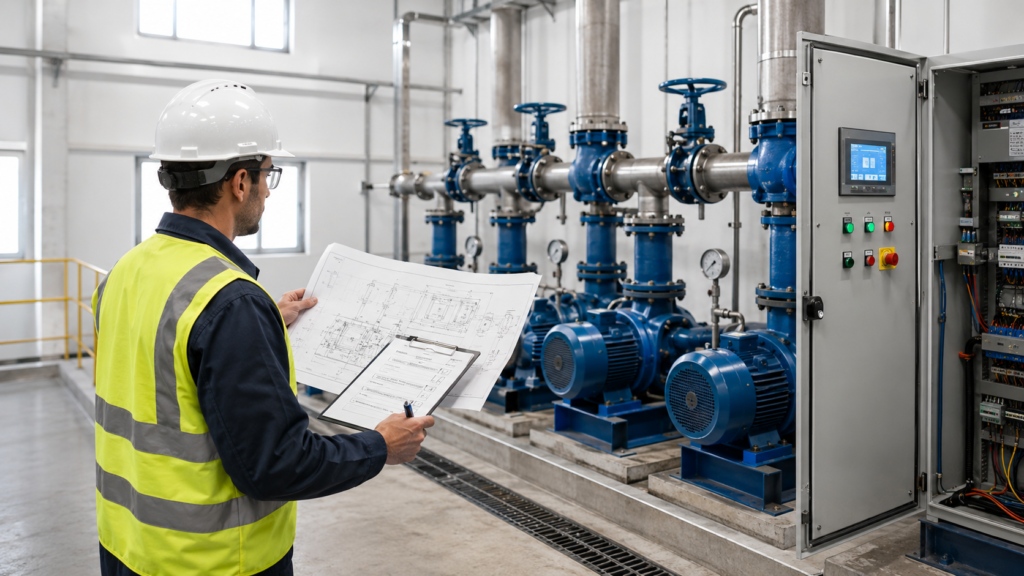
The first step in any pump station commissioning checklist is reviewing the approved project documents. These may include pump curves, mechanical drawings, electrical schematics, panel layouts, equipment submittals, control diagrams, and the intended sequence of operation.
Technicians should confirm that the installed pumps, motors, VFDs, valves, sensors, and control panels match the approved specifications. Important values such as pump horsepower, voltage, full-load amperage, design flow, operating pressure, and alarm requirements must be verified before startup begins.
Any difference between the approved plans and the installed system should be documented. Even a minor equipment substitution can affect electrical loading, pump performance, control logic, or long-term reliability.
This review is also an opportunity to confirm that the station has been built according to the intended operating conditions. CLEF Industries’ engineering services and new project design and installation services can help ensure equipment selection and system design align with project requirements.
2. Inspect Pumps, Motors, Valves, and Piping
Before energizing the station, complete a visual inspection of the site and installed equipment. The station should be clean, accessible, and free from temporary wiring, construction debris, loose materials, or blocked access points.
Each pump should be checked for the correct model, size, impeller, orientation, and mounting arrangement. Pump bases and fasteners should be secure, and the connected piping should not place excessive stress on the equipment.
Alignment is particularly important for centrifugal, vertical turbine, and end-suction pumps. Poor alignment can increase vibration, damage seals and bearings, and reduce efficiency. Submersible systems require inspection of guide rails, discharge connections, lift chains, and sealing surfaces.
Motor information should be compared with the approved design. Confirm voltage, horsepower, full-load amperage, grounding, overload protection, insulation condition, and bearing condition. Motor rotation must also be checked before full operation because an incorrect phase sequence can cause reverse rotation and poor pump performance.
The piping system should be reviewed at the same time.
| Component | Main commissioning concern |
|---|---|
| Check valve | Correct flow direction and reliable closure |
| Isolation valve | Correct startup position and full movement |
| Pressure-relief valve | Proper setting and safe discharge path |
| Flanges and gaskets | Alignment, bolt tightness, and leakage |
| Pipe supports | Movement, vibration, and equipment loading |
| Air-release equipment | Trapped air and unstable flow |
Technicians should look for leaks, unsupported piping, incorrect valve positions, and signs that water could enter electrical areas. These issues should be corrected before the station proceeds to live testing.
3. Check Electrical Power and Control Panels
Electrical inspection must be performed by qualified personnel before the station is fully energized. Main disconnects, circuit breakers, fuses, overloads, relays, contactors, terminal blocks, transformers, and power supplies should all be checked.
Wire terminations must be secure and properly labelled. Grounding and bonding should match the project requirements, while the control wiring should be compared with the approved schematics. Loose or incorrect electrical connections can cause intermittent faults, voltage drops, overheating, and equipment damage.
Panel ventilation is another important part of a pump station commissioning checklist. Excessive heat can reduce the service life of VFDs, PLCs, power supplies, and other electronic components. Fans, filters, heaters, cabinet seals, and clearances should suit the surrounding environment.
Where custom panels or system upgrades are involved, CLEF Industries’ fabrication services can support properly designed and assembled control solutions.
4. Program and Test VFDs or Motor Starters
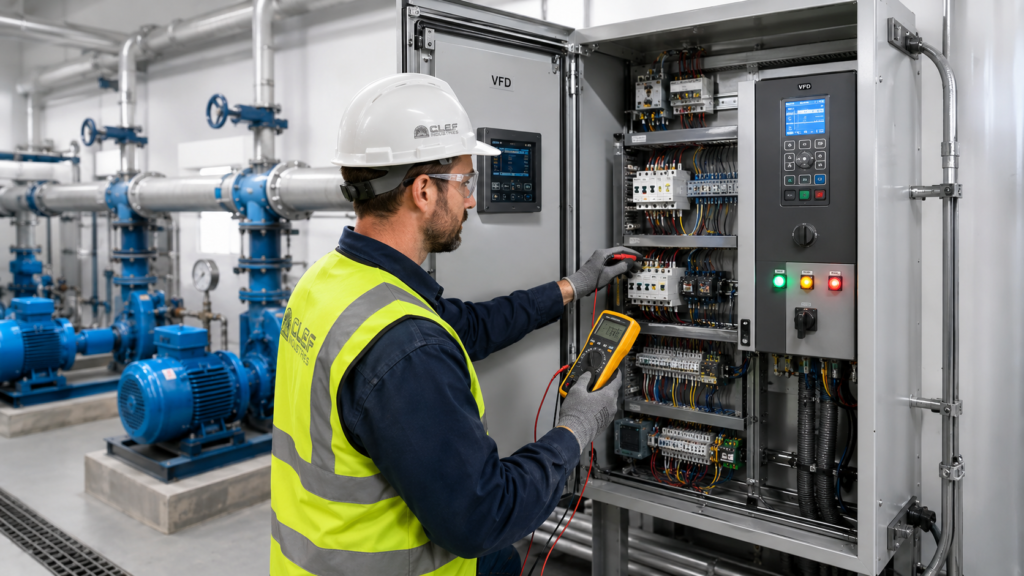
Variable Frequency Drives are commonly used to regulate pump speed, stabilize system pressure, reduce energy consumption, and limit mechanical stress. However, a VFD must be configured specifically for the connected motor and pump application.
Motor nameplate information should be entered accurately. Technicians should then verify minimum and maximum speed limits, acceleration and deceleration times, current limits, control mode, communication settings, and fault response.
Where pressure or flow control is used, PID settings must be tested under changing demand. Poorly tuned controls can cause pressure fluctuations, rapid speed changes, repeated cycling, or nuisance faults.
The commissioning team should confirm:
- Hand, off, and automatic operation
- Correct start and stop commands
- Stable speed and pressure response
- Proper current limits and fault protection
- Bypass operation where installed
For multi-pump systems, each VFD or starter should respond correctly during lead-lag operation and periods of increased demand. CLEF’s VFD troubleshooting services can help diagnose programming, communication, and operating issues.
5. Calibrate Sensors and Test Control Logic
Sensors provide the information that allows a pump station to operate automatically. If a pressure transducer, level sensor, flow meter, or switch is incorrectly installed or calibrated, the control system may make the wrong decision even when the pumps are working correctly.
Technicians should verify installation location, wiring, scaling, calibration, and response for all instrumentation. Field readings should be compared with values shown on the PLC, HMI, controller, or SCADA system.
For example, a pressure transducer may produce an electrical signal while still displaying an inaccurate pressure value. This can cause unstable VFD operation, rapid pump cycling, poor pressure control, or false alarms.
After confirming the sensors, test the complete operating sequence. Manual and automatic modes should respond correctly, while all start and stop conditions should match the approved design.
For duplex and multi-pump stations, confirm that pumps alternate correctly, lead-lag sequencing works as intended, and the lag pump starts when demand increases.
Important control functions include manual operation, automatic control, emergency stops, manual overrides, system communications, and restart behaviour following an acceptable power interruption.

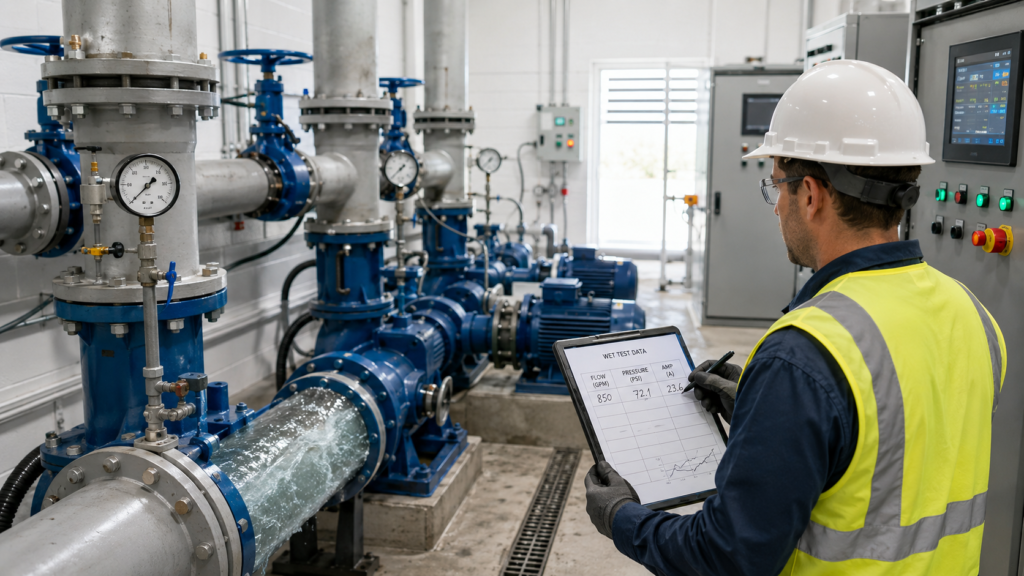
Technician calibrating pump station sensors and pressure instruments.
6. Verify Alarms, Wet Testing, and Performance
An alarm should not be considered operational until it has been deliberately activated and observed. Test high-level, low-level, pump-failure, motor-overload, VFD-fault, pressure, phase-loss, power-failure, and communication alarms individually.
Local lights and horns should operate correctly, but remote communication must also be confirmed. If the station connects to a SCADA system, dialer, building automation platform, or monitoring service, verify that the correct message reaches the intended operator.
Wet testing is one of the most important stages of the pump station commissioning checklist because it confirms performance under actual hydraulic conditions.
Technicians should record flow rate, suction pressure, discharge pressure, motor amperage, VFD frequency, runtime, vibration, temperature, and response time.
| Test reading | What it helps confirm |
|---|---|
| Flow rate | Whether the station reaches required capacity |
| Discharge pressure | Whether the system reaches its operating target |
| Motor amperage | Whether the motor is overloaded |
| VFD frequency | Whether speed control responds correctly |
| Vibration and noise | Whether alignment or hydraulic conditions need attention |
| Start and stop points | Whether sensors and control logic are configured correctly |
If performance falls below expectations, investigate valve positions, piping restrictions, sensor calibration, pump selection, and VFD settings.
Technicians should also listen for cavitation, rattling, bearing noise, or unusual vibration. Excessive heat at motors, terminals, or VFD enclosures may indicate loose connections, overload, or poor ventilation.
7. Test Backup Power, Document Results, and Train Operators
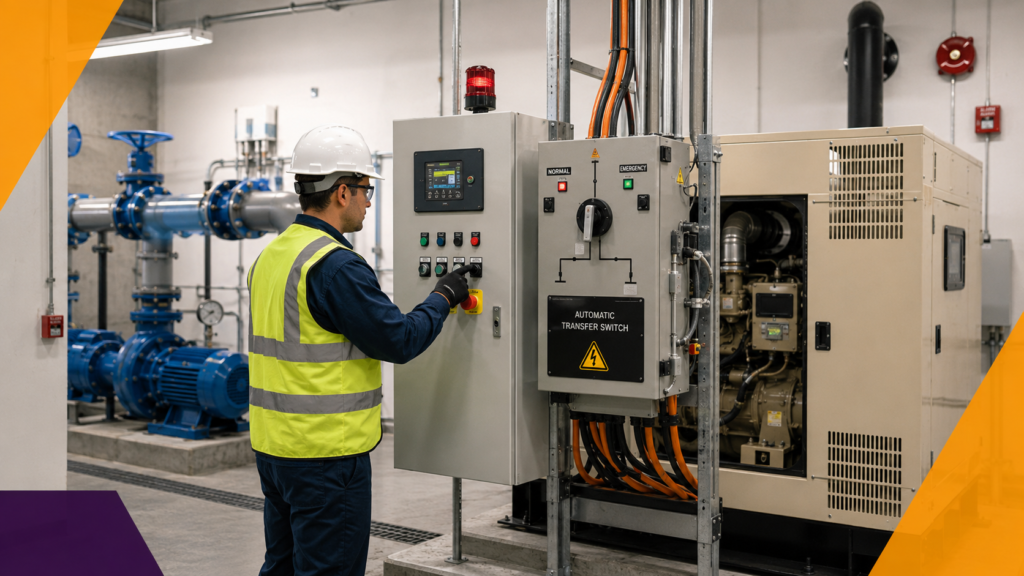
Where backup power is installed, the generator, automatic transfer switch, emergency controls, and restart sequence should be tested before final turnover.
The team should confirm how the station responds when normal power is lost, how quickly backup power becomes available, and whether the pumps restart in a safe sequence. Alarm communication should remain active, and the control system should retain important settings.
The test should verify generator startup, transfer-switch operation, emergency controls, manual overrides, and alarms during a power failure.
Commissioning is not complete until the results are documented. Records should include equipment information, voltage and amperage readings, VFD parameters, sensor calibration values, flow and pressure results, alarm tests, deficiencies, and corrective actions.
These records establish a baseline for future maintenance. If the station later develops a fault, technicians can compare current values with the original commissioning data.
Operators should also receive practical training. They should understand normal operating modes, alarm meanings, reset procedures, emergency shutdown steps, basic maintenance needs, and who to contact when specialist support is required.
Quick Pump Station Commissioning Checklist
Before final turnover, confirm that:
- Installed equipment matches the approved drawings.
- Pumps, motors, valves, and piping have been inspected.
- Electrical wiring, grounding, and protection are correct.
- VFDs, sensors, controls, and alarms have been tested.
- Wet-test readings meet the design requirements.
- Backup power and emergency systems operate correctly.
- Commissioning results have been documented.
- Operators have received appropriate training.
How CLEF Industries Can Help
Pump station commissioning requires coordination across mechanical, electrical, hydraulic, and control disciplines. A fault in one area can affect the reliability of the complete system.
CLEF Industries supports pump station projects through engineering, fabrication, new project design and installation, control-panel support, equipment upgrades, VFD troubleshooting, and system testing.
Professional support can help identify startup issues early, improve operating performance, and reduce the risk of unexpected downtime. For additional technical reference, operators can also review equipment-specific installation and commissioning instructions provided by the original pump and VFD manufacturers.
Conclusion
Following a pump station commissioning checklist gives owners, contractors, and operators a structured way to confirm that the station is safe, reliable, and ready for service.
By reviewing project documents, inspecting mechanical and electrical systems, configuring VFDs, calibrating sensors, testing alarms, and recording wet-test results, commissioning teams can reduce the risk of equipment failure after startup.
A careful commissioning process protects critical equipment, improves long-term performance, and creates a dependable foundation for future maintenance.
For assistance with pump station commissioning, startup testing, engineering, VFD troubleshooting, or control systems, contact CLEF Industries to discuss your project.