
Pump Station Winterization and Blow-Out Guide for Northeast Properties
A single freeze event in an unprepared pump station can cost five figures in damage and shut down spring operations for weeks. In the Northeast, where frost lines run 36 to 48 inches and overnight temperatures drop below freezing for months at a stretch, winterization is not optional. This guide walks through when to schedule service, what gets winterized, how the blow-out procedure actually works, freeze protection options beyond the basics, and the documentation that protects you when things go wrong.
The audience here is golf course superintendents, vineyard managers, farm operators, municipal facility managers, and commercial property owners running pump stations in Connecticut, Massachusetts, New York, New Jersey, Pennsylvania, and the broader Northeast.
Why Pump Station Winterization Is Non-Negotiable in the Northeast
Skipping winterization is one of the most expensive mistakes a property owner can make. The damage from a single freeze event compounds quickly across pumps, piping, valves, and instrumentation, and the repair bill almost always exceeds the cost of professional winterization by 10 to 20 times.
The Real Cost of a Freeze Event
When water freezes inside a pump station, it expands by roughly 9 percent. That expansion is enough to crack pump casings, split impellers, destroy mechanical seals, burst suction and discharge piping, ruin check valves and air release valves, and damage pressure transducers and flow meters. Backflow preventers, which trap water in their internal chambers, are the single most commonly destroyed component on irrigation systems.
Typical freeze repair costs by system size:
- Small residential or light commercial irrigation: $2,000 to $8,000
- Mid-size commercial or agricultural pump station: $8,000 to $20,000
- Golf course or large agricultural system: $15,000 to $40,000 or more
These figures cover parts and labor. They do not include operational downtime, which on a golf course or commercial farm during spring start-up can run far higher than the repair itself.
What Northeast Climate Actually Does to Equipment
The Northeast subjects pump stations to two specific threats: sustained sub-freezing temperatures and the freeze-thaw cycle. Sustained cold freezes any standing water in pipes and components. The daily freeze-thaw cycle, where temperatures swing above and below 32°F repeatedly, is even harder on seals, gaskets, and joints because the repeated expansion and contraction work fasteners loose and crack materials over time.
Frost line depth across the Northeast typically runs 36 to 48 inches, with parts of northern Maine, upstate New York, and northern New Hampshire approaching 60 inches. Anything above grade is fully exposed. Anything buried but improperly drained is still at risk.
Insurance and Warranty Implications
Most equipment manufacturer warranties explicitly exclude freeze damage on systems that were not properly winterized. Pump warranties from Goulds, Berkeley, Sulzer, and other major brands all carry this language. Property insurance often classifies freeze damage as preventable and may deny claims when the policyholder cannot document that winterization service was performed.
Documented professional winterization protects you on both fronts. Skipping it puts both the equipment warranty and the insurance coverage at risk.
When to Winterize Your Pump Station in the Northeast
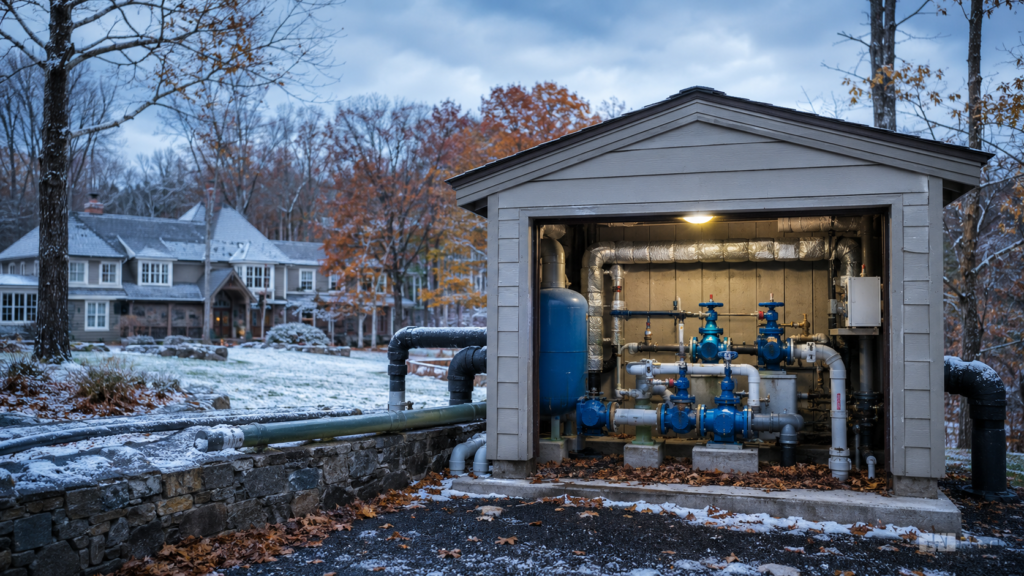
Timing matters more than most operators realize. Schedule too late, and you risk a hard freeze before service is complete. Schedule too early, and you leave the system inoperable during periods you may still need it.
The Right Window by Region
The target is to complete winterization two to three weeks before the first hard frost in your area. Hard frost is defined as overnight temperatures at or below 28°F for four or more consecutive hours.
Typical service windows by region:
- Northern New England, Vermont, New Hampshire, Maine: late September through mid-October
- Upstate New York and western Massachusetts: late September through mid-October
- Connecticut and southern Massachusetts: mid-October through late October
- Coastal Connecticut, southern New York, New Jersey: mid-October through early November
- Pennsylvania interior and Hudson Valley: early to mid-October
These windows shift slightly year to year based on weather patterns, but they hold up well as planning targets.
Watching the Forecast
Do not wait for the first freeze warning to schedule. Reputable pump station service providers book up four to six weeks in advance during peak season. By the time the forecast shows consecutive nights at 32°F, the work should already be done, not starting.
The right trigger to schedule service is the calendar, not the thermometer. If you are in coastal Connecticut, schedule for late October. If you are in upstate New York, schedule for early October. Then watch the forecast as a backup check, not the primary signal.
When You Can Push It Later
A few situations allow for later winterization or skipping it entirely:
- Heated indoor pump houses with reliable heat and backup power
- Year-round operating systems where continuous flow prevents freezing
- Buried pump stations with all components below the frost line and full drainage on any above-grade piping
Even in these cases, above-grade piping, exposed instrumentation, and any drained sections still require attention. A heated enclosure does nothing for the suction line that runs above grade between the source and the pump.
What Gets Winterized in a Pump Station
A complete winterization addresses every component that holds water or is exposed to freezing temperatures. Missing one trap point can void the entire effort.
Pumps and Motors
Centrifugal pumps, vertical turbine pumps, and submersible pumps all require attention. Pump casings must be drained completely through their drain plugs. Mechanical seals can crack if water freezes against the seal faces. Volute drains and casing drains often need to be opened manually because gravity drainage alone leaves residual water at low points.
Submersible pumps installed below the frost line generally do not require freeze protection on the pump itself, but the discharge piping above grade and the well head components do.
Suction and Discharge Piping
This is where most freeze damage occurs. All above-grade piping must be drained or blown clear. Suction piping is particularly important because it sits below pump elevation and traps water that gravity drainage cannot remove. Manifolds, headers, and dead-leg connections all hold water that needs to be addressed deliberately.
Valves and Control Hardware
Check valves, butterfly valves, ball valves, gate valves, foot valves, solenoid valves, and air release valves all have internal chambers that hold water. Each valve type has specific drainage requirements. Backflow preventers are the single most overlooked component on irrigation systems and the most commonly destroyed by freezing. Their internal check chambers hold water that gravity will not drain, and they require deliberate draining or removal.
Sensors, Gauges, and Instrumentation
Pressure transducers, pressure gauges, magnetic flow meters, level switches, and float switches all contain water-filled chambers or sensing elements that freeze and crack. Magnetic flow meters are particularly vulnerable because their entire bore stays full of water. Sensors and gauges should be drained, isolated, or removed and stored indoors, depending on their type and value.
Filtration and Treatment Equipment
Sand filters, disc filters, screen filters, fertigation injection systems, and chlorination equipment all hold water and chemicals. Each needs to be drained, flushed, and in some cases disassembled for indoor storage. Chemical injection lines should be purged completely to prevent freeze damage and chemical residue buildup.
Control Panels and VFDs
Control panels and VFD enclosures do not hold water but are vulnerable to condensation cycling. Verify enclosure heaters are working, gaskets are intact, and pest entry points are sealed. VFDs in particular are sensitive to moisture, and condensation inside a drive enclosure during freeze-thaw cycles is a leading cause of board failure on pump stations that sit idle through winter.
The Pump Station Blow-Out Procedure Step by Step
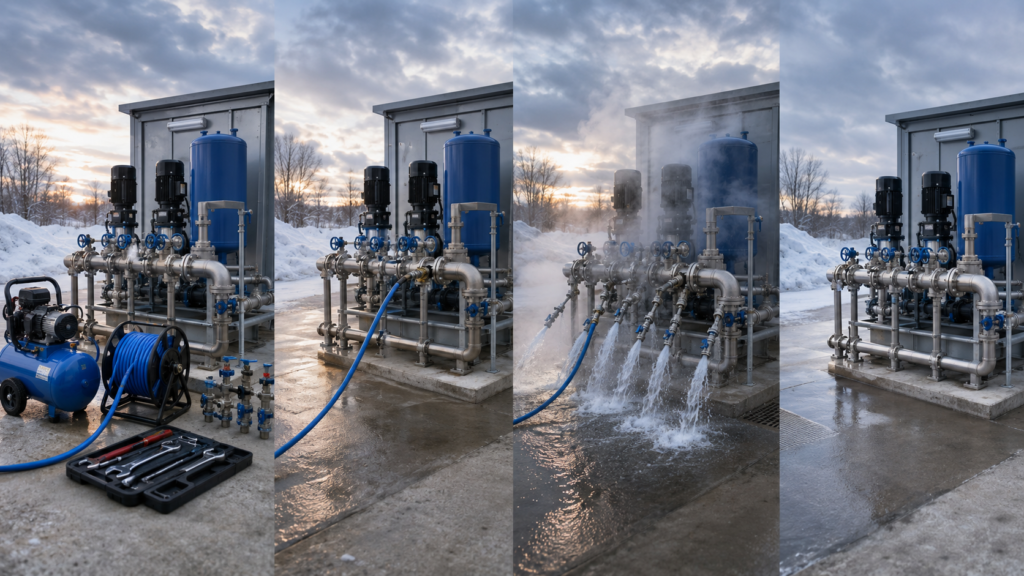
The blow-out is the core of winterization. Done right, it removes every trace of water from the system. Done wrong, it damages components that were perfectly fine before the compressor arrived.
Before the Compressor Arrives
Map the system before any air goes in. Identify every drain point, low spot, blow-off valve, air injection port, and zone valve. Confirm system pressure ratings on the most pressure-sensitive components, typically drip emitters, pressure gauges, and certain solenoid valves. Lock out and tag out all electrical disconnects on pumps, motors, and VFDs. Close the main supply valve from the source and open all manual drains at low points to gravity drain whatever the system will give up before air is introduced.
Sizing the Air Compressor for Your System
Compressor sizing is about CFM, not PSI. The compressor needs to deliver enough volume of air to push all standing water through the system at a safe pressure. PSI requirements are typically 50 to 80 PSI for most applications, much lower than the compressor can produce.
Typical CFM requirements by system size:
- Small irrigation systems under 5 zones: 80 to 185 CFM
- Medium commercial irrigation: 185 to 375 CFM
- Large golf course or municipal systems: 375 to 750 CFM
- Very large agricultural or golf operations: 750 CFM and above
A 750 CFM diesel air compressor is the workhorse for golf courses and large commercial winterization. Undersized compressors leave residual water in long pipe runs and force longer dwell times that damage components.
The Step-by-Step Blow-Out Sequence
The procedure runs in this order:
- Confirm electrical lockout on all pumps, motors, and VFDs
- Close the main supply valve from the source
- Open all manual low-point drains and let gravity remove what it can
- Drain pump casings through their drain plugs
- Connect compressed air at the designated injection point
- Open the furthest zone first, away from the compressor
- Apply air at 50 to 80 PSI maximum, lower for drip systems
- Run air through the zone until only fine mist or dry air exits the heads, not standing water
- Close that zone and move to the next, working back toward the compressor
- Drain remaining manifolds, headers, and dead legs
- Address backflow preventers separately by opening their test cocks and draining the internal chambers
- Remove gauges, transducers, and any removable instrumentation for indoor storage
- Document the work with photos, written records, and a service report
Pressure and Time Limits That Protect Your System
Two rules prevent most blow-out damage:
Maximum 80 PSI for standard rotary and impact head irrigation systems. Maximum 50 PSI for drip irrigation, micro-sprinkler systems, and low-pressure emitters. Exceeding these limits cracks fittings, blows out emitters, and ruptures lateral lines.
Maximum 60 seconds of continuous air on a single zone. After 60 seconds, close the zone and move to the next. The reason is that compressed air heats up significantly as it moves through piping, and prolonged air on one zone melts gear drives in rotor heads and damages seal cups in spray heads. Rotate zones rather than holding air on any single section.
The Mistakes That Cause Damage During Blow-Out
Pressure too high. Running 100+ PSI on a system rated for 80 splits fittings and destroys emitters. The compressor may produce 175 PSI, but a regulator on the air line is mandatory.
Air is on too long. Holding compressed air in a single zone for two or three minutes melts plastic gear drives in rotor heads. The 60-second rule exists for a reason.
Skipping low-point drains before applying air. The blow-out is supposed to clear residual water, not move large volumes of standing water through the system at high velocity.
Forgetting backflow preventers. They will freeze and crack regardless of how well the rest of the system was blown out.
Wrong order. Starting at the closest zone instead of the furthest creates pressure traps that damage components and leave residual water in the long runs.
Skipping the pump casing drain. Pumps hold water that the suction-side blow-out does not remove. The casing drain plug must be opened manually.
Freeze Protection Options Beyond Blow-Out
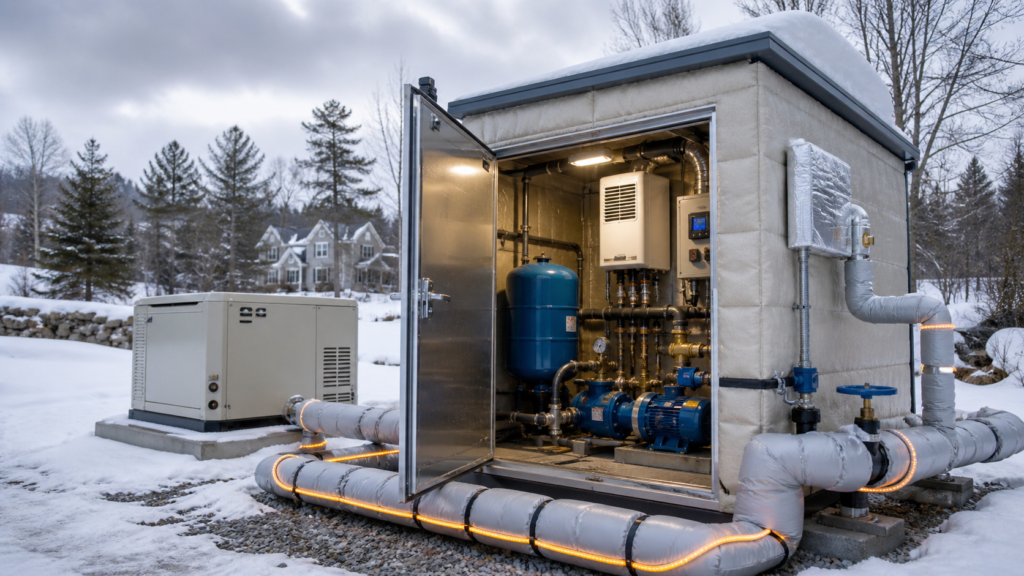
For some systems, blow-out alone is not enough or not practical. Several freeze protection options layer on top of or replace the standard procedure, depending on the application.
Heated Enclosures and Pump Houses
A heated enclosure maintains internal temperatures above freezing through the winter, eliminating the need for full system drainage on equipment housed inside. Common for municipal pump stations, year-round commercial systems, and any application where the pump station runs during winter months.
Construction options range from insulated prefabricated enclosures to fully constructed pump houses with HVAC. Costs run from $5,000 to $50,000+, depending on size, insulation rating, and heating capacity. Reliable heat and backup power are critical because a power outage during a January storm turns a heated pump house into a freeze trap with all the water still in the system.
Heat Tape and Pipe Insulation
Electric heat tape paired with pipe insulation works well for short above-grade pipe runs, exposed risers, and isolated components. Self-regulating heat tape is the standard choice because it adjusts output based on pipe temperature.
The major weakness is power dependency. Heat tape fails during power outages, which is exactly when freeze risk is highest. For critical applications, heat tape should be backed up by either generator power or full system drainage as a fallback.
Glycol Loops for Critical Systems
Glycol loops circulate a propylene glycol solution through coils or jackets around equipment that cannot be drained. The application is mostly limited to fire suppression pumps governed by NFPA 20, certain HVAC pump systems, and specific industrial processes where continuous operation is required.
Glycol systems are not common on irrigation or general transfer pump stations. The annual maintenance and chemistry monitoring required typically outweighs the benefit unless the system genuinely cannot be shut down for winter.
Burying Below Frost Line
For new construction, burying piping below the regional frost line eliminates freeze risk on the buried portions. In most of the Northeast, this means 48 inches minimum, with northern regions requiring 60 inches or more. Above-grade equipment, exposed risers, and any component above the frost line still require winterization regardless of how deep the mainline runs. Burying does not eliminate the need for winterization; it just reduces the scope.
Special Considerations by Property Type
Different property types have different equipment, different priorities, and different winterization requirements.
Golf Courses
Golf course pump stations typically serve 100 to 200 acres of irrigated turf through extensive mainline networks and hundreds of zones. Winterization on a large course typically requires a full day with a 750 CFM compressor and a multi-person crew. Special attention goes to quick couplers, satellite control boxes, fertigation systems, and the pump station itself.
Coordination with the superintendent on the final irrigation cycle and final fertigation flush is critical. Schedule winterization for after the last irrigation event but before the first hard frost.
Vineyards and Orchards
Drip and micro-irrigation systems on vineyards and orchards require a lower blow-out pressure of 40 to 50 PSI maximum to avoid damaging emitters and dripline. Filtration stations are typically more elaborate than on turf systems and need extra attention. Frost protection irrigation systems, when used, have their own winterization requirements and must be coordinated with the main blow-out.
Farms and Agricultural Operations
Farm pump stations vary widely from large field irrigation pumps drawing from ponds or wells to smaller utility pumps for livestock watering and processing. Suction lines from open water sources need particular attention because they often run above grade for considerable distances. Pivot irrigation systems have their own winterization requirements separate from the pump station itself.
Municipal and Commercial Properties
Municipal pump stations serving public water, fire suppression, or wastewater applications require professional service with full documentation for compliance purposes. Backflow preventer testing and certification requirements vary by state and water utility. Coordination with the water utility for service shutoffs may be required for portions of the procedure.
Pump Stations on Wells
Submersible pumps below the frost line do not require freeze protection on the pump itself. Above-grade components do: pressure tanks, pressure switches, well house piping, pitless adapters, and any electrical components in unheated enclosures. Wellhead seals should be inspected for cracks and gasket condition before winter.
VFD and Control Panel Winter Care
VFDs require specific attention separate from the mechanical winterization. The risks are condensation, thermal cycling, and pest intrusion, not freezing water.
Why VFDs Need Special Attention in Winter
Condensation inside a VFD enclosure during freeze-thaw cycles is the leading cause of drive failure on pump stations that sit idle through winter. Moisture forms on cold internal surfaces, drips onto circuit boards, and corrodes connections over the course of three to four months of inactivity. Spring start-up then surfaces faults that were not present at shutdown.
Pre-Winter VFD Checklist
- Verify enclosure heaters are operating and rated for the enclosure volume
- Inspect door gaskets and seals for cracks or compression set
- Check filter cleanliness on forced-ventilation enclosures
- Seal any pest entry points around cable glands and conduit fittings
- Document all VFD parameter settings to a backup file or a printed record
- Note current run hours and any active fault codes
- Confirm that any condensation drain paths are clear
Idle Period Management
Two approaches work for VFDs over winter. The first is to leave the control power energized to maintain enclosure heater operation throughout the winter, which prevents condensation but consumes power. The second is to fully de-energize the VFD and rely on enclosure sealing and desiccant packs to manage humidity. The first is more reliable for critical equipment. The second is acceptable for short winters and well-sealed enclosures, though it carries more risk.
The Pre-Winterization Inspection Checklist
A pre-winterization inspection identifies issues that need attention before service or before spring. Address them now rather than discovering them during start-up:
Mechanical seals showing wear, weeping, or stains. Bearings are making noise or running hot during the final operating cycle. Coupling alignment and condition. Suction strainers and screens for cleaning. Pressure relief valves for proper operation and seat condition. Check valves for full closure and reverse flow. Air release valves for clean function. Pressure gauges for accuracy against a known reference. Backflow preventer condition for upcoming spring testing. Control panel interior for moisture, corrosion, or pest evidence. VFD fault history and run hours. Pump station enclosure for water intrusion, gasket condition, and ventilation function.
The pre-winterization period is also the right time to address known issues. Replacing a worn mechanical seal in October is straightforward. Discovering it failed during spring start-up under pressure is a different problem entirely.
Documentation and Records
Documentation protects you on insurance claims, warranty issues, and year-over-year system management. It also makes the next winterization faster and more reliable.
What to Document
- Date of service and weather conditions
- Technicians on site and credentials
- Compressor model and CFM rating used
- Maximum PSI applied per zone or section
- Components removed for indoor storage
- VFD parameter snapshots and fault history
- Photos of the pump station condition before and after service
- Notes on any issues observed for the spring follow-up
- List of any parts replaced during service
- Recommendations for spring start-up or repairs
Why Documentation Matters
Insurance claims for any future freeze damage require proof that winterization was performed. Equipment warranty support requires the same. Knowledge transfer between operators or service providers is far easier with written records than with verbal handoff. Year-over-year comparison surfaces gradual deterioration that single-year inspection misses. Municipal and commercial properties often have regulatory documentation requirements separate from equipment protection.
Spring Start-Up: What Winterization Sets You Up For
Proper winterization makes spring start-up a routine procedure rather than a damage assessment. The start-up sequence runs roughly opposite to winterization: slow refilling to prevent water hammer, air bleeding from high points, pressure testing before full pressurization, VFD power-up and parameter verification, sensor verification, and an initial irrigation cycle with monitoring.
Schedule start-up after the threat of hard freeze has passed for your region, typically late April in northern New England and early to mid-April in coastal Connecticut and points south. Watch the forecast for the same reason you watched it in fall: a late-April hard freeze will damage a system that was successfully drained six months earlier and just refilled.
Cost of Professional Pump Station Winterization
Cost varies based on system size, complexity, and travel. Typical ranges:
- Small residential or light commercial irrigation: $200 to $500
- Mid-size commercial or agricultural systems: $500 to $1,500
- Large commercial, municipal, or vineyard systems: $1,500 to $4,000
- Golf courses or large agricultural operations: $3,000 to $8,000+
What is typically included: full blow-out, drain procedures, removable component storage, written service report, and recommendations for spring follow-up.
What is typically not included: replacement parts, repairs identified during service, and spring start-up service. These are usually quoted separately.
The math on professional service is simple. A $1,500 winterization on a 50 HP commercial irrigation pump station is insurance against a potential $20,000 freeze repair. The decision is rarely close once the numbers are on the table.
DIY vs Professional Winterization
The DIY question depends on system complexity, equipment availability, and the operator’s experience.
When DIY Makes Sense
Small residential irrigation systems with fewer than 5 zones, well pumps with simple above-ground discharge piping, and basic single-pump systems where the operator has access to an appropriately sized compressor and understands the procedure. Even in these cases, the operator needs the right compressor (rental at minimum), a working knowledge of the system, and the discipline to follow the 60-second zone rule and pressure limits.
When You Need a Professional
Anything above 5 HP. Anything with a VFD or complex controls. Commercial properties, golf courses, vineyards, agricultural operations of any meaningful size, and municipal systems. Anything with multiple pumps, lead-lag controls, or fertigation. Anything where the cost of damage from a botched winterization exceeds the cost of professional service many times over.
The realistic cutoff is this: if the system is worth more than $25,000 to replace, hire a professional. The service cost is a fraction of the replacement cost, and the professional carries insurance on the work.
When to Bring in an Expert
Beyond annual winterization, expert input is valuable on system assessment for upcoming retrofits, troubleshooting recurring issues, evaluating freeze protection upgrades, and planning for facility expansion. A qualified pump station service provider can identify weak points before they fail, recommend cost-effective protection upgrades, and produce documentation that satisfies insurance and warranty requirements.
CLEF Industries has been servicing pump stations across the Northeast for over fifty years, with expertise spanning winterization, repair, VFD service, and full system retrofits. For scheduling winterization service, spring start-up, or a pre-winter system assessment, contact our team to get on the calendar before peak season fills.
Conclusion
In the Northeast, pump station winterization is not optional. The cost of doing it right is a small fraction of the cost of getting it wrong, and the consequences of skipping it land directly on equipment, operations, and insurance coverage.
Schedule service two to three weeks before the first hard frost in your region. Document the work properly. Address known issues before winter rather than discovering them at spring start-up. For anything beyond a small residential system, hire a professional with the right equipment, experience, and insurance.
A well-winterized pump station starts up in spring. A neglected one starts up in pieces.
FAQ
When should I schedule pump station winterization in Connecticut?
For Connecticut properties, schedule winterization for mid-October through late October to complete service two to three weeks before the typical first hard frost. Coastal areas can extend slightly later into early November. Do not wait for the first 32°F overnight forecast to schedule. Reputable service providers book up four to six weeks in advance, so call in late August or September to lock in your slot.
How much does pump station winterization cost?
Professional winterization runs $200 to $500 for small residential irrigation, $500 to $1,500 for mid-size commercial systems, $1,500 to $4,000 for large commercial or municipal pump stations, and $3,000 to $8,000+ for golf courses and large agricultural operations. Cost depends on system size, number of zones, complexity of controls, and travel distance.
Can I winterize my pump station myself?
DIY makes sense only for small residential systems with simple piping, basic well pumps with minimal above-ground equipment, and operators who have access to a properly sized compressor and understand the procedure. For anything above 5 HP, anything with a VFD, or any commercial property, hire a professional. The risk of damage from a botched DIY winterization on a complex system is far higher than the cost of professional service.
What happens if my pump station freezes?
Frozen water expands by roughly 9 percent, which is enough to crack pump casings, split impellers, destroy mechanical seals, burst piping, and damage check valves, backflow preventers, and pressure transducers. Repair costs typically run $2,000 to $8,000 for small systems, $8,000 to $20,000 for mid-size systems, and $15,000 to $40,000 or more for large commercial and golf course systems. Operational downtime during spring start-up often exceeds the repair cost itself.
How long does pump station winterization take?
A small residential or light commercial system takes 30 minutes to 90 minutes. A mid-size commercial pump station typically takes 2 to 4 hours. A large vineyard, agricultural, or municipal system runs 4 to 8 hours. Golf course winterization typically requires a full day with a multi-person crew and a high-CFM compressor.
Do I need to winterize a heated pump house?
Yes, with reduced scope. The heated enclosure protects what is inside, but any piping running outside the heated space, exposed risers, and components above the frost line still require winterization. Heated enclosures also depend on continuous power, and a multi-day power outage during a January storm can freeze a heated pump house as completely as an unheated one. Backup power or partial drainage of vulnerable sections is sound practice even with a heated enclosure.
What is the difference between blow-out and winterization?
Blow-out is one specific step within the broader winterization process. The blow-out uses compressed air to clear standing water from piping and components. Winterization includes the blow-out plus pump casing drainage, valve drainage, instrumentation handling, control panel and VFD preparation, removable component storage, freeze protection on remaining vulnerable equipment, and full documentation. Saying “we did the blow-out” is not the same as saying “we winterized the system.”
When should I schedule the spring start-up after winterization?
Schedule the spring start-up after the threat of a hard freeze has passed for your region. Typical windows: mid-April for coastal Connecticut, southern New York, and New Jersey; late April for inland Connecticut, Massachusetts, and Hudson Valley; late April to early May for upstate New York, Vermont, New Hampshire, and Maine. Watch the 10-day forecast before scheduling because a late-April hard freeze will damage a system that has just refilled.