VFD vs Soft Starter: Which One Does Your Pump Station Actually Need?
Most pump stations are running the wrong starting equipment. Either they are over-engineered with a VFD when a soft starter would do the job, or they are under-engineered with a soft starter when a VFD would have paid for itself inside two years. The cost of getting it wrong shows up in three places: upfront capital, energy bills, and pump life.
This guide gives you a clear decision framework for choosing between a VFD and a soft starter on a centrifugal pump application. We cover what each device actually does, the six factors that decide which one fits your system, real cost ranges, and the mistakes that cost pump operators money every year.
The focus here is on centrifugal pumps used in irrigation, water and wastewater, HVAC, and industrial transfer. Positive displacement pumps follow different rules and are outside the scope of this article.
Quick Answer for Busy Engineers
If your pump runs at the same speed every time it operates and demand stays constant, a soft starter is usually enough. If your flow or pressure demand varies, even a little, a Variable Frequency Drive almost always wins on total cost of ownership and often pays back in one to three years through energy savings alone.
Here is the short comparison:
| Factor | Soft Starter | VFD |
|---|---|---|
| Speed control during operation | No | Yes, fully variable |
| Energy savings during run | None | Significant on variable loads |
| Upfront cost (50 HP, equipment only) | $2,000 to $5,000 | $5,000 to $12,000 |
| Best application | Constant-speed pumps | Variable-demand systems |
| System complexity | Low | Moderate to high |
| Soft stop capability | Limited | Yes, full control |
The detailed reasoning for each factor follows below.
What a Soft Starter Actually Does
A soft starter is a motor control device that gradually ramps up the voltage delivered to the motor during start-up only. It solves a specific problem: the violent inrush current and mechanical shock that happens when you connect a motor directly to full line voltage.
How It Works
Soft starters use Silicon Controlled Rectifiers, commonly called SCRs or thyristors, to control the voltage waveform reaching the motor. When the start command is given, the SCRs begin conducting at a small phase angle, delivering a fraction of full voltage. Over a programmed ramp time, typically five to thirty seconds, the conduction angle increases until the motor receives full line voltage and reaches full speed.
In modern soft starters, a bypass contactor closes once the motor reaches full speed, taking the SCRs out of the circuit to eliminate heat losses during normal operation.
The benefits during start-up are real:
- Inrush current drops from 600 to 800 percent of full load amps down to roughly 200 to 400 percent
- Mechanical shock to the motor shaft, couplings, and pump impeller is reduced
- Water hammer on start-up is dampened significantly
- Pipe and joint stress is lower across the entire system
What It Doesn’t Do
Here is the critical point most specifiers miss. Once the motor reaches full speed, the soft starter is essentially out of the circuit. It provides no speed control, no flow regulation, and no energy savings during operation. The motor runs at full nameplate speed every time it is on, regardless of whether the system actually needs that much flow or pressure.
Some advanced soft starters offer a controlled stop function that ramps voltage down, which helps with water hammer on shutdown. But there is no continuous speed control, and that single limitation is what makes soft starters the wrong choice for most variable-demand pump applications.
What a VFD Actually Does
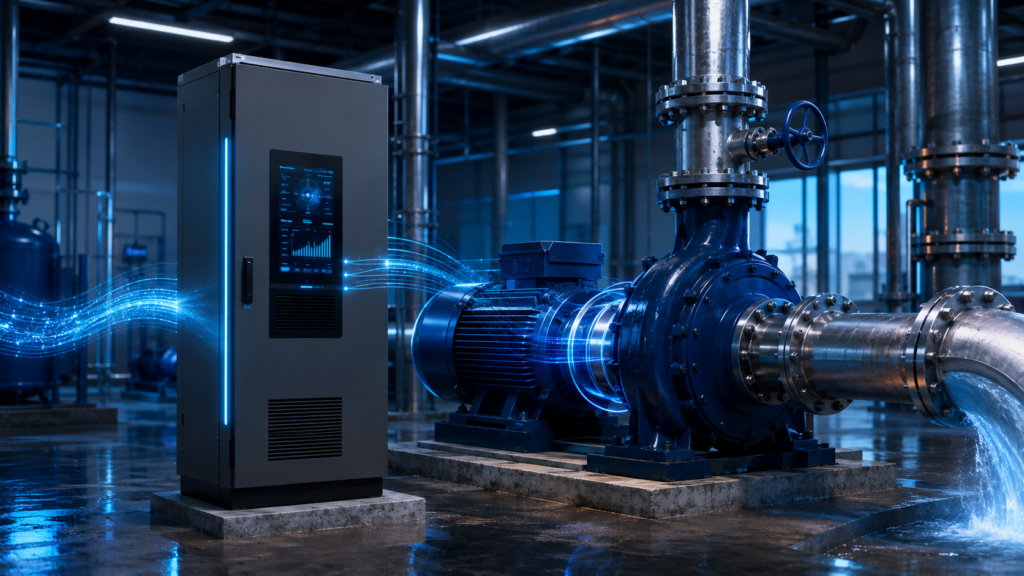
A Variable Frequency Drive controls both the frequency and the voltage delivered to a motor, allowing infinitely variable speed from near zero up to and beyond nameplate speed. On a centrifugal pump, this changes the economics of the entire installation.
How It Works
A VFD has three main stages. The rectifier converts incoming AC power to DC. The DC bus, with its capacitor bank, smooths and stores that DC voltage. The inverter then uses Insulated Gate Bipolar Transistors, or IGBTs, to switch the DC voltage into a synthesized AC waveform at whatever frequency and voltage the application requires. This is called Pulse Width Modulation, or PWM.
By varying frequency, the VFD controls motor speed. By varying the voltage proportionally to frequency, it maintains motor torque across the speed range. This gives you a single device that handles soft starting, soft stopping, full speed control, motor protection, and energy optimization.
For a deeper look at common VFD problems and how to address them, see our guide on how to troubleshoot VFD issues in pump stations.
The Affinity Laws: Why VFDs Win on Pumps Specifically
The reason VFDs deliver such strong returns on centrifugal pumps comes down to physics. The pump affinity laws describe how flow, pressure, and power change with speed:
- Flow varies directly with speed
- Pressure varies with the square of speed
- Power varies with the cube of speed
That third relationship is the money-maker. If you reduce pump speed by 20 percent, the pump still delivers 80 percent of full flow, but power consumption drops to roughly 51 percent of full load. Slow the pump to 70 percent speed, and you cut power consumption nearly in half.
A soft starter cannot access any of these savings because the motor always runs at full speed. The pump output is then choked back with throttling valves, which waste the excess energy as heat and turbulence in the piping. With a VFD, you simply slow the pump down to match demand, and the savings flow straight to the bottom line.
The 6 Decision Factors That Actually Matter
1. Is Your Flow Demand Variable or Constant?
This is the first question to answer. If your pump operates against a varying system curve, with demand changing through the day or across seasons, a VFD is almost always the right choice.
Examples of variable demand applications:
- Irrigation systems with multiple zones cycling on and off
- Pressure boosting systems serving variable building demand
- Multi-pump lift stations with changing inflow
- HVAC chilled water and condenser water loops
- Process pumps with variable batch requirements
Truly constant-demand applications are rarer than people assume, but do exist:
- Dedicated transfer pumps moving fixed volumes between tanks
- Fire pumps governed by NFPA 20 requirements
- Some cooling tower makeup pumps
- Standby or backup pumps that run rarely
2. Energy Savings Potential
For variable-demand pumps, the energy savings from a VFD are usually the dominant economic factor. Consider a 50 HP pump running 4,000 hours per year at $0.12 per kWh.
Running across the line, that pump consumes roughly 160,000 kWh per year, costing about $19,200 in electricity. With a VFD optimizing speed to match demand on a typical variable load profile, energy use often drops by 25 to 40 percent. That translates to $4,800 to $7,700 in annual savings on a single pump.
For pumps over 25 HP running more than 2,000 hours per year, the energy savings alone usually justify the VFD inside two to three years.
3. Upfront Cost Reality
VFDs cost more than soft starters. Here are typical equipment ranges, equipment only, before installation:
| Pump Size | Soft Starter | VFD |
|---|---|---|
| 10 HP | $800 to $2,000 | $1,500 to $3,500 |
| 50 HP | $2,000 to $5,000 | $5,000 to $12,000 |
| 100 HP | $4,000 to $8,000 | $10,000 to $20,000 |
| 200 HP | $7,000 to $14,000 | $18,000 to $35,000 |
These are ballpark figures. Actual pricing depends on brand, features, enclosure rating, and current market conditions.
The cost picture does not stop at the device. VFD installations often require additional considerations such as larger control panel enclosures, ventilation or cooling for heat dissipation, line reactors or harmonic filters, and shielded VFD-rated motor cable. For a detailed walkthrough of installation cost factors, see our breakdown of the cost to retrofit an existing pump station with a VFD.
4. Mechanical Wear, Water Hammer, and Pump Life
Both devices reduce the violent shock of across-the-line starting. The difference is what happens during shutdown and during normal operation.
Across-the-line starts and stops cause water hammer, the pressure wave that slams pipes, joints, and check valves. A soft starter mitigates start-up hammer, but most cannot fully control stop ramps. A VFD provides full ramp control on both start and stop, eliminating water hammer in both directions.
During normal operation, a VFD-controlled pump running at part load experiences lower bearing loads, lower seal face pressures, and reduced impeller stress. Pump life on variable-speed installations typically extends by 20 to 40 percent compared to throttled constant-speed operation.
5. Harmonics and Power Quality
VFDs introduce harmonic distortion into the electrical system. The PWM switching action draws current in non-sinusoidal pulses, which creates harmonics primarily at the 5th, 7th, 11th, and 13th orders. On a small installation, this rarely matters, but on facilities with multiple large drives, it can cause problems, including transformer overheating, neutral conductor overloading, sensitive equipment malfunctions, and IEEE 519 compliance issues with the utility.
Mitigation options include line reactors, DC chokes, passive harmonic filters, active front-end drives, and 18-pulse or higher rectifier configurations. Each adds cost and complexity.
Soft starters do introduce harmonics during the brief ramp period, but once at full speed and bypassed, they draw a clean sinusoidal current. In facilities where harmonic distortion is a serious constraint and mitigation is impractical, a soft starter may be the better choice on that factor alone.
6. Complexity, Maintenance, and Operator Skill
Soft starters are mechanically and electrically simpler than VFDs. Fewer components, fewer parameters to configure, fewer failure modes, and easier troubleshooting for site electricians.
VFDs are more capable but demand more from your operations team. Setup and tuning require knowledge of motor parameters, application profiles, and protection settings. Heat management is critical, and ventilation problems are one of the most common causes of premature drive failure. For a deep dive into thermal failure modes, see our article on VFD overheating solutions.
VFDs also have more failure modes overall. Capacitor aging, IGBT failures, control board faults, and cooling fan failures are all real maintenance concerns. Our guide on what causes VFD failure and how to prevent it covers these in detail, and our 10 essential maintenance and troubleshooting tips for VFDs provide a practical maintenance checklist.
When a Soft Starter Is the Right Call
Specify a soft starter when the application meets most of these conditions:
- Pump operates at constant flow and pressure demand
- Run hours are low, typically under 2,000 hours per year
- The upfront budget is severely constrained
- Harmonic distortion is a serious concern with no practical mitigation
- The pump is a backup or standby unit that runs infrequently
- The application is a fire pump where NFPA 20 governs the installation
- Operator skill on site is limited, and a simpler device reduces support burden
Soft starters are not obsolete. They are the right tool for genuinely constant-speed work where the only problem you need to solve is start-up shock and inrush current.
When a VFD Is the Right Call (Most Pump Stations)
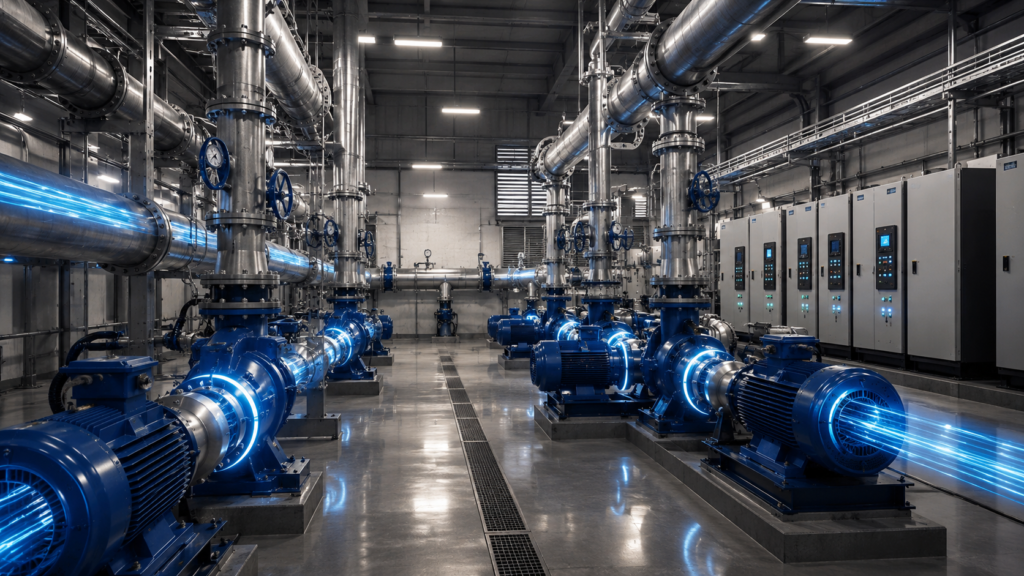
Specify a VFD when the application meets any of these conditions:
- Demand varies during normal operation, even modestly
- Annual run hours exceed 2,000
- Energy code compliance is required, including ASHRAE 90.1 or state energy codes
- The system uses pressure or flow control via throttling valves today
- Multiple pumps need coordinated lead, lag, and lag-lag operation
- Water hammer must be eliminated on both start and stop
- The motor experiences frequent starts that cause heating concerns
- Long-term total cost of ownership is the priority
For most modern pump stations, the VFD is the default answer. The exceptions are real but they are exceptions.
The Hybrid Setup When You Need Both
Multi-pump stations often use a hybrid approach. One or two pumps run on VFDs to handle variable demand, and the remaining pumps run on soft starters or across the line as base-load units cycling on and off as demand requires.
A common four-pump booster station configuration looks like this. One VFD-controlled lead pump trims output to match real-time demand. The lag pumps come online sequentially with soft starters when demand exceeds what the lead pump can handle alone. As demand drops, lag pumps drop out, and the lead VFD pump trims back down.
This setup gets you variable speed control where it matters, without paying for VFDs, you would never run at part load. It also provides operational redundancy because the lead and lag roles can rotate among pumps.
Real Cost Breakdown by Pump Size
Equipment costs are only part of the picture. Below is an indicative total installed cost comparison for a typical pump station retrofit:
| Pump Size | Soft Starter Installed | VFD Installed | Annual Energy Savings (Variable Load) | VFD Payback |
|---|---|---|---|---|
| 10 HP | $2,500 to $5,000 | $4,000 to $8,000 | $400 to $900 | 3 to 5 years |
| 50 HP | $5,000 to $10,000 | $10,000 to $20,000 | $4,800 to $7,700 | 1.5 to 3 years |
| 100 HP | $9,000 to $18,000 | $20,000 to $40,000 | $9,000 to $15,000 | 2 to 3 years |
| 200 HP | $15,000 to $30,000 | $35,000 to $70,000 | $18,000 to $30,000 | 1.5 to 2.5 years |
These figures assume a typical variable load profile with an average pump speed of around 70 percent. Constant-load applications will not show similar savings, which is exactly why the variable demand question matters so much.
Common Mistakes That Cost Pump Operators Money
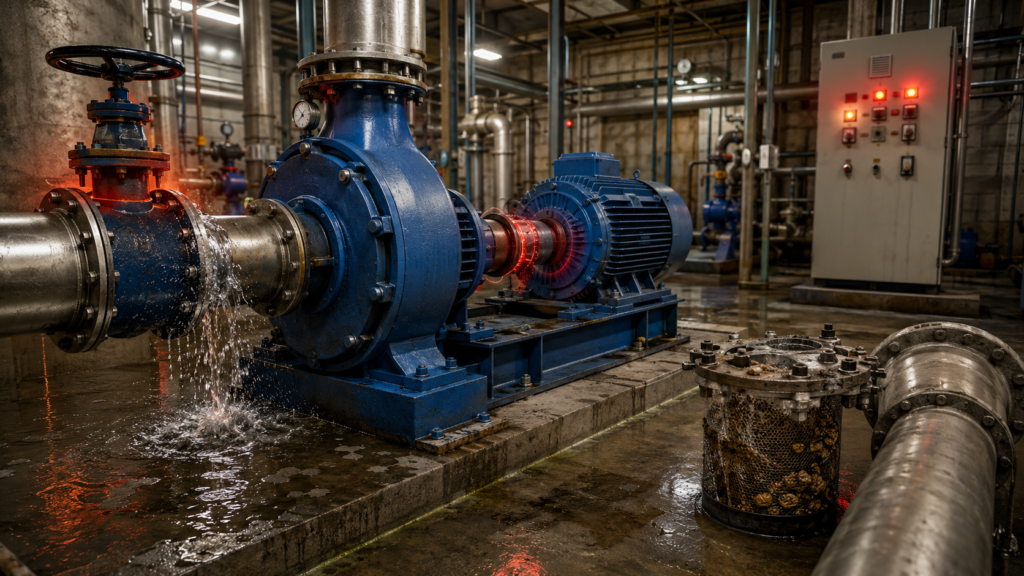
Buying a soft starter on a variable-load pump to save on capital cost. The savings get burned in the first 18 to 24 months of wasted energy.
Oversizing the VFD beyond actual motor requirements. Larger drives run less efficiently at part load and cost more to buy.
Ignoring motor cable length and dV/dt effects. Long leads between a VFD and motor cause voltage reflections that destroy motor insulation. For a complete walkthrough on this, see our guide on how to terminate VFD cable.
Skipping harmonic mitigation in facilities with multiple drives. The cost of fixing harmonic problems after the fact is always higher than designing for them up front.
Failing to specify variable torque settings during VFD commissioning. A VFD configured for constant torque on a centrifugal pump leaves significant energy savings on the table.
Defaulting to across-the-line starting because it has always worked. On any motor above 25 HP running variable loads, this is usually a five-figure mistake repeated every year.
A Simple Decision Framework
Run through these five questions to land on the right answer:
- Does pump demand vary by more than 20 percent during normal operation? If yes, lean VFD.
- Does the pump run more than 2,000 hours per year? If yes, the VFD energy savings likely justify the cost.
- Is energy code compliance required? If yes, a VFD is usually mandatory.
- Is harmonic distortion a hard constraint with no mitigation budget? If yes, a soft starter is the safer choice.
- Is upfront capital severely constrained, and the pump duty truly constant? If yes, a soft starter is acceptable.
If two or more answers point to a VFD, specify the VFD. If the application is genuinely constant duty with low run hours, the soft starter is your answer.
When to Bring in an Expert
Sizing the right drive for a pump curve is not a spec sheet exercise. It depends on the pump duty cycle, the system curve, the load profile across seasons, and the existing electrical infrastructure. Retrofitting a VFD into an existing pump station involves enclosure space, ventilation, harmonic study, motor compatibility checks, and proper commissioning.
CLEF Industries has been designing, installing, and retrofitting pump stations across the East Coast for over fifty years. Our team handles the full scope from drive selection through panel fabrication, installation, commissioning, and long-term service. If you are weighing a VFD or soft starter decision on an existing or new pump station, reach out for a site assessment or learn more about our VFD repair, installation, and troubleshooting services.
Conclusion
Pumps are variable torque loads, and that single fact is why VFDs win on most pump stations despite costing more upfront. The affinity laws turn part-load operation into real money. A soft starter solves only the start-up problem and leaves all the operational savings on the table.
The right answer depends on your duty cycle, run hours, demand profile, and electrical environment. For constant-speed, low run-hour applications, a soft starter is genuinely the right tool. For everything else, which is the majority of modern pump stations, the VFD is the answer.
Specify the equipment that matches the application, not the equipment that matches the lowest line item on the bid. The energy savings, the pump life extension, and the operational flexibility add up to a clear winner on most installations.
FAQ
Can you replace a soft starter with a VFD?
Yes. A VFD can replace a soft starter in most pump applications and typically delivers better performance and energy savings. The retrofit involves verifying motor compatibility, sizing the drive correctly, providing adequate ventilation, and addressing cable runs and harmonics. Most existing motors work with VFDs, but motors over 10 to 15 years old should be checked for inverter-duty rating.
Do VFDs really save energy on pumps?
Yes, on variable demand applications, the savings are substantial. Because pump power consumption varies with the cube of speed, even modest speed reductions produce large energy savings. A pump running at 70 percent average speed consumes roughly 34 percent of full load power. On constant demand applications, a VFD will not save energy because the pump still runs at full speed.
Are VFDs worth it for small pumps under 10 HP?
It depends on run hours and load profile. For a 10 HP pump running 1,000 hours per year on a relatively constant load, a soft starter or even across-the-line starting is often more economical. For the same pump running 5,000 hours per year with variable demand, a VFD usually pays back within three years.
Will a soft starter prevent water hammer?
A soft starter reduces water hammer on start-up by ramping motor speed and pressure gradually instead of slamming the system with full pressure instantly. However, most soft starters do not provide controlled deceleration on stop, so water hammer on shutdown remains a concern. A VFD with programmed ramp-down times is the only motor control device that eliminates water hammer in both directions.